From “Concept to Completion” — What End-to-End Really Means at BIM Syncro
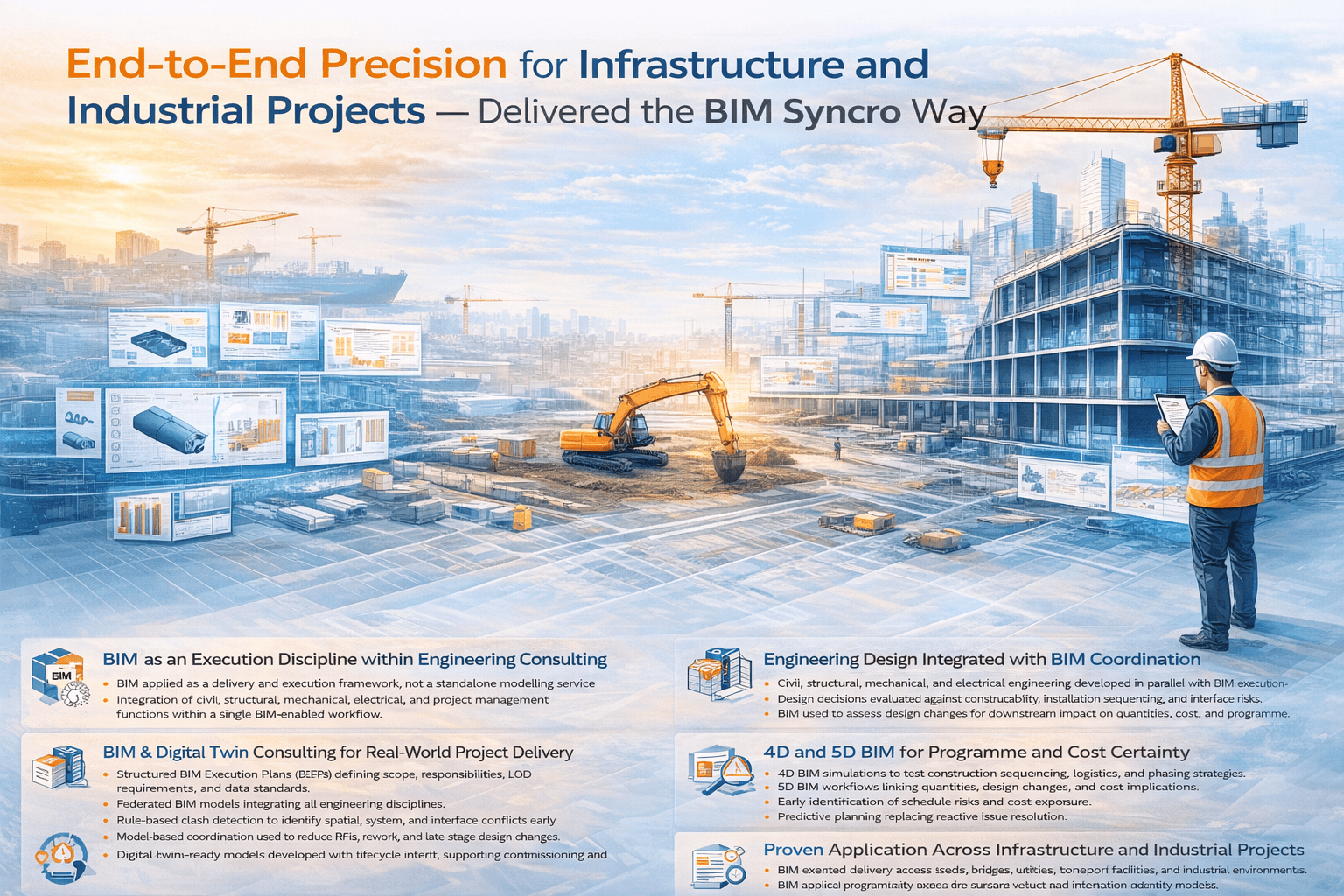
BIM Syncro Engineers Sdn Bhd practices true end-to-end construction delivery—using integrated BIM, digital engineering, and multidisciplinary expertise—to materially improve cost certainty, buildability, approvals, and long-term asset performance for its clients. It draws directly from BIM Syncro’s stated capabilities and real project experience reflected in its About Us and Track Record pages.
From “Concept to Completion” — What End-to-End Really Means at BIM Syncro
In construction, “end-to-end” is often used loosely. At BIM Syncro, it has a precise meaning: continuity of engineering intent, data, and accountability across the entire project lifecycle—from feasibility to operations.
BIM Syncro does not treat BIM as a drawing tool or a marketing visual. It is used as a delivery backbone, ensuring that decisions made early survive contact with reality later—on site, during approvals, and in operations.
This approach is evident in both the breadth of services offered and the types of projects delivered, spanning infrastructure, industrial facilities, high-rise buildings, data centres, healthcare, ports, roads, and oil & gas works.
Reference:
-
Track Record: https://www.bimmalaysia.com/about/track-record
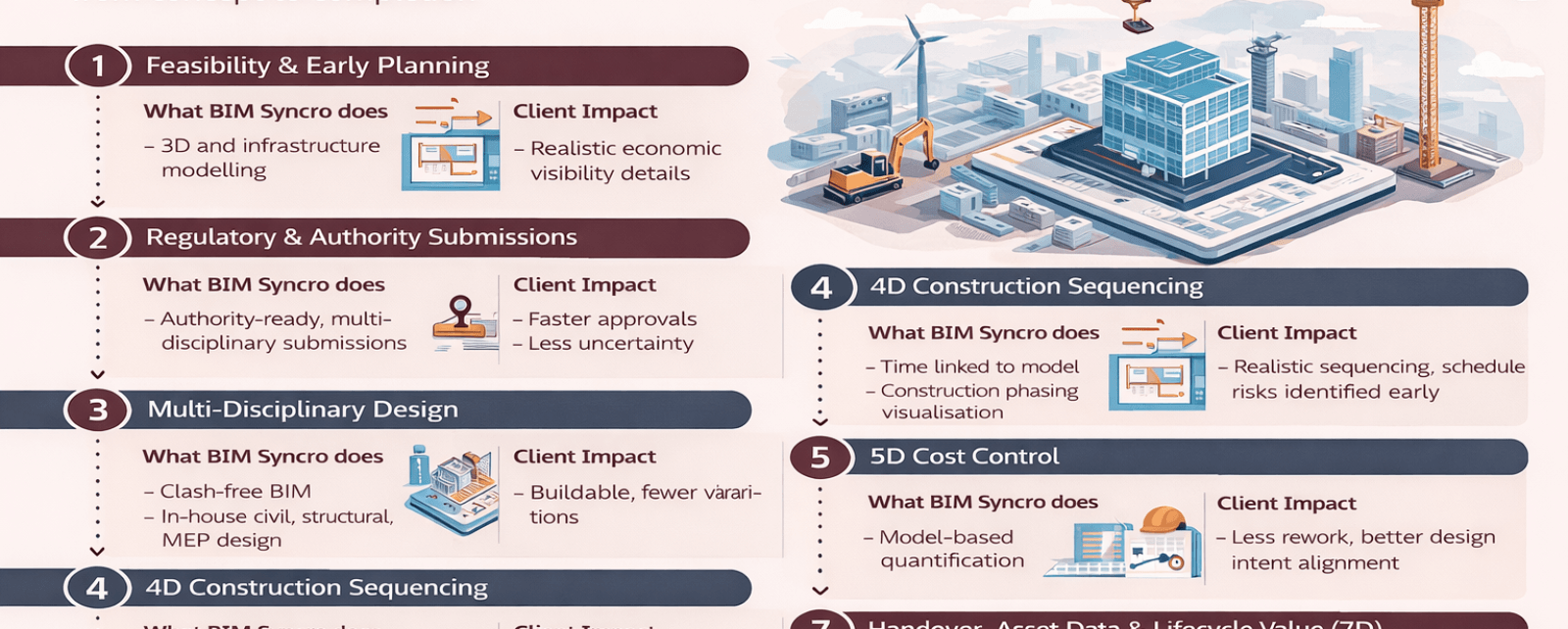
How BIM Syncro Applies End-to-End Delivery Across the Project Lifecycle
1. Feasibility & Early Planning — Getting the Economics Right First
Many projects fail quietly at feasibility. BIM Syncro integrates engineering judgement, spatial analysis, and early modelling to test ideas before capital is committed.
What BIM Syncro does
-
Early-stage 3D and infrastructure modelling
-
Spatial and constructability analysis
-
Design-for-cost and design-for-build reviews
Client impact
-
Unrealistic schemes are filtered out early
-
Developers gain clearer CAPEX/OPEX visibility
-
Authorities see technically grounded proposals, not speculative sketches
This capability is particularly evident in infrastructure, industrial, and complex mixed-use developments listed in BIM Syncro’s track record.
2. Regulatory & Authority Submissions — Reducing Approval Friction
Regulatory delays are one of the most underestimated risks in construction. BIM Syncro’s Regulatory Approval (RA) consultancy is integrated directly with its BIM workflows.
What BIM Syncro does
-
Authority-ready BIM and engineering documentation
-
Coordinated civil, structural, and MEP submissions
-
Independent Checking Engineer (ICE) services where required
Client impact
-
Fewer resubmissions
-
Faster technical clearance
-
Reduced approval uncertainty for financiers and boards
This is especially critical for government-linked projects, utilities, healthcare, and infrastructure works reflected in BIM Syncro’s portfolio.
3. Multi-Disciplinary Design — Eliminating Silos Before They Hit Site
Traditional projects fracture responsibility between architects, engineers, and contractors. BIM Syncro’s strength lies in its multi-disciplinary in-house engineering team, spanning:
-
Civil & Structural Engineering
-
Mechanical & Electrical Engineering
-
Infrastructure & Geotechnical Engineering
-
BIM, simulation, and project controls
Reference: About Us page
What BIM Syncro does
-
Federated BIM models integrating all disciplines
-
Early clash detection and resolution
-
Clear Level of Development (LOD) governance
Client impact
-
Reduced variations during construction
-
Better tender pricing due to lower uncertainty
-
Fewer disputes driven by design ambiguity
This capability is repeatedly demonstrated in BIM Syncro’s industrial plants, roadworks, bridges, and high-complexity facilities.
4. 4D Construction Sequencing — Time Made Visible
Schedules on paper lie. BIM Syncro integrates time (4D) directly into models to simulate construction sequencing, logistics, and access constraints.
What BIM Syncro does
-
4D simulations using Navisworks / Synchro
-
Construction phasing visualisation
-
Site logistics and interface planning
Client impact
-
More realistic programmes
-
Early identification of sequencing risks
-
Better coordination between contractors and specialists
This is particularly valuable in constrained urban sites, operational facilities, and infrastructure corridors.
5. 5D Cost Control — Turning Models into Commercial Tools
Cost overruns rarely come from one big mistake—they come from hundreds of small ones. BIM Syncro uses 5D BIM to link quantities and cost data directly to the model.
What BIM Syncro does
-
Model-based quantity take-offs
-
Design-option cost comparison
-
Support for value engineering decisions
Client impact
-
Improved budget predictability
-
Faster evaluation of design changes
-
Reduced exposure to claims and variations
This directly supports BIM Syncro’s stated focus on cost optimisation based design.
6. Construction Support — Bridging Design and Site Reality
BIM Syncro does not disappear after design freeze. The firm supports construction teams with model-based coordination, responding to real-world site constraints.
What BIM Syncro does
-
Construction-stage BIM coordination
-
Technical clarifications grounded in the model
-
Independent checks and engineering validation
Client impact
-
Faster issue resolution
-
Less rework
-
Better alignment between design intent and site execution
7. Handover, Asset Data & Lifecycle Value — Beyond Practical Completion
Most projects stop caring once keys are handed over. BIM Syncro extends value into operations and maintenance readiness (7D).
What BIM Syncro does
-
As-built BIM models
-
Asset information structuring
-
Data suitable for FM and digital twin platforms
Client impact
-
Lower long-term operating costs
-
Easier maintenance and upgrades
-
Assets that remain understandable years after construction
Why BIM Syncro’s End-to-End Model Matters to Clients
Across its track record, BIM Syncro consistently delivers outcomes that matter in the real world:
-
Fewer surprises during construction
-
Lower risk premiums in contractor pricing
-
Faster approvals
-
Assets that perform, not just look good
This aligns with global evidence that integrated digital delivery can reduce project costs by up to 20% and improve schedules by up to 30%:
-
ISO 19650 (BIM lifecycle standard): https://www.iso.org/standard/68078.html
Conclusion: End-to-End Is Not a Buzzword at BIM Syncro
At BIM Syncro, end-to-end delivery is not branding—it is how risk is removed, value is protected, and performance is engineered.
By combining multidisciplinary engineering, BIM across 3D–7D, regulatory expertise, and real construction experience, BIM Syncro ensures that projects are not merely completed—but completed with certainty, clarity, and long-term value.
In an industry where fragmentation still dominates, BIM Syncro’s end-to-end model represents what construction is slowly—but inevitably—becoming.
Recommended Post
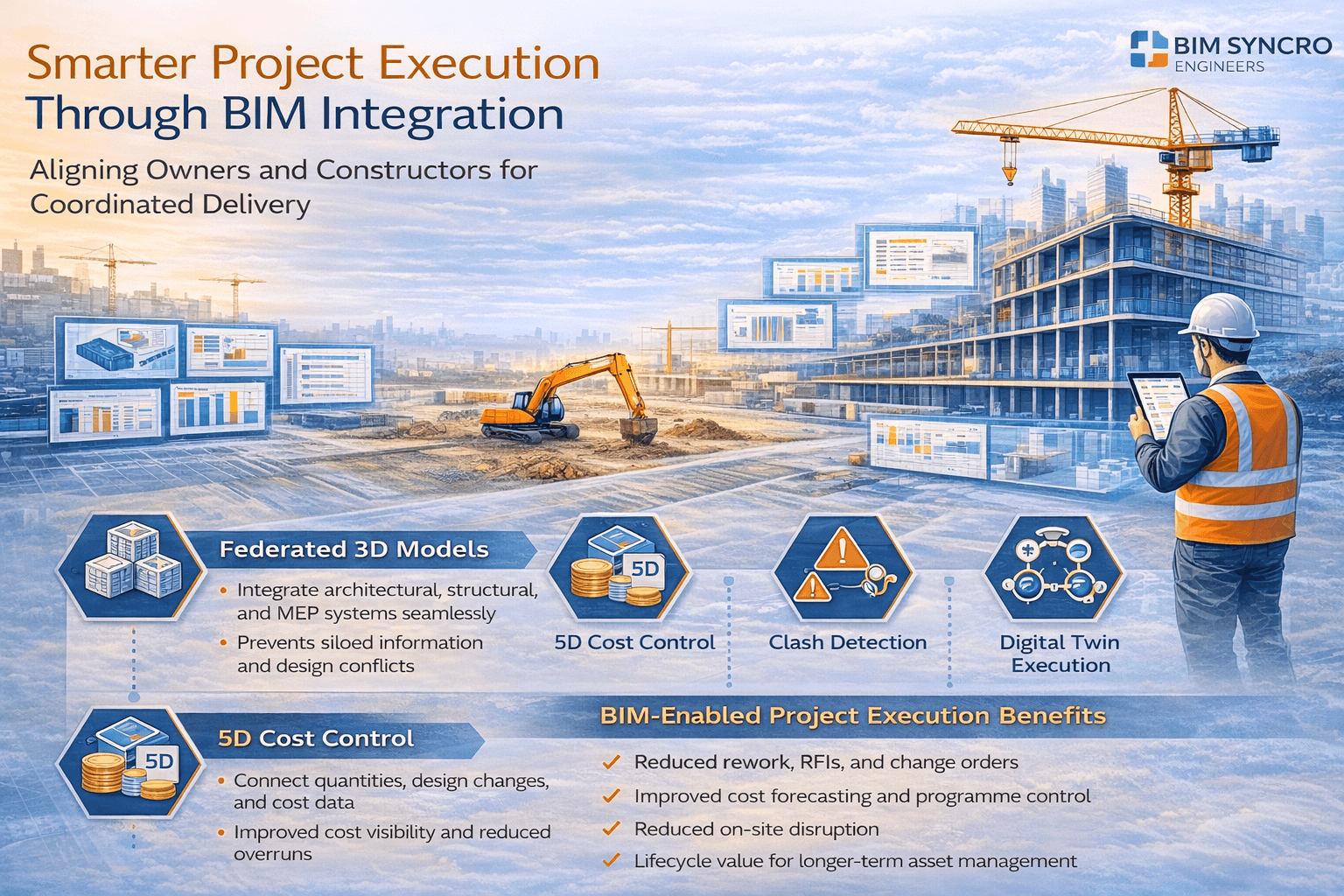

Transforming Project Delivery with Real-Time Digital Simulation