How To Unlock Predictive Intelligence for Operations and Design

Meeting PeDATA & SKATA under Pekeliling Perbendaharaan PK 1.15 — the BIM Syncro way
The Malaysian compliance reality
Under Pekeliling Perbendaharaan PK 1.15, government and GLC projects are no longer judged by drawings alone. They are judged by data quality, structure, traceability, and lifecycle usability.
PeDATA and SKATA formalise this requirement by demanding:
-
Consistent asset identification and classification
-
Structured attributes suitable for handover and operations
-
Auditability across planning, construction, and asset management
Yet on the ground, many projects still fail—not because BIM is absent, but because BIM is delivered as geometry instead of intelligence.
Common industry pain points:
-
BIM models look complete but contain unstructured or unusable data
-
Asset parameters are added late, breaking PeDATA / SKATA continuity
-
Overseas BIM outsourcing delivers models that ignore Malaysian authority workflows
-
SMEs face high barriers: software costs, licensing complexity, and lack of experienced BIM staff
What BIM Syncro does differently
1. Compliance is designed in, not patched on
BIM Syncro structures BIM delivery from project inception to meet Malaysian public-sector data expectations:
-
Asset data schemas aligned to PeDATA and SKATA, not generic libraries
-
LOD strategies tied to handover and operations, not just design milestones
-
Clear data lineage suitable for PK 1.15 audit and governance review
This avoids the common end-of-project scramble to “make the model compliant.”
2. BIM as predictive intelligence—not just 3D
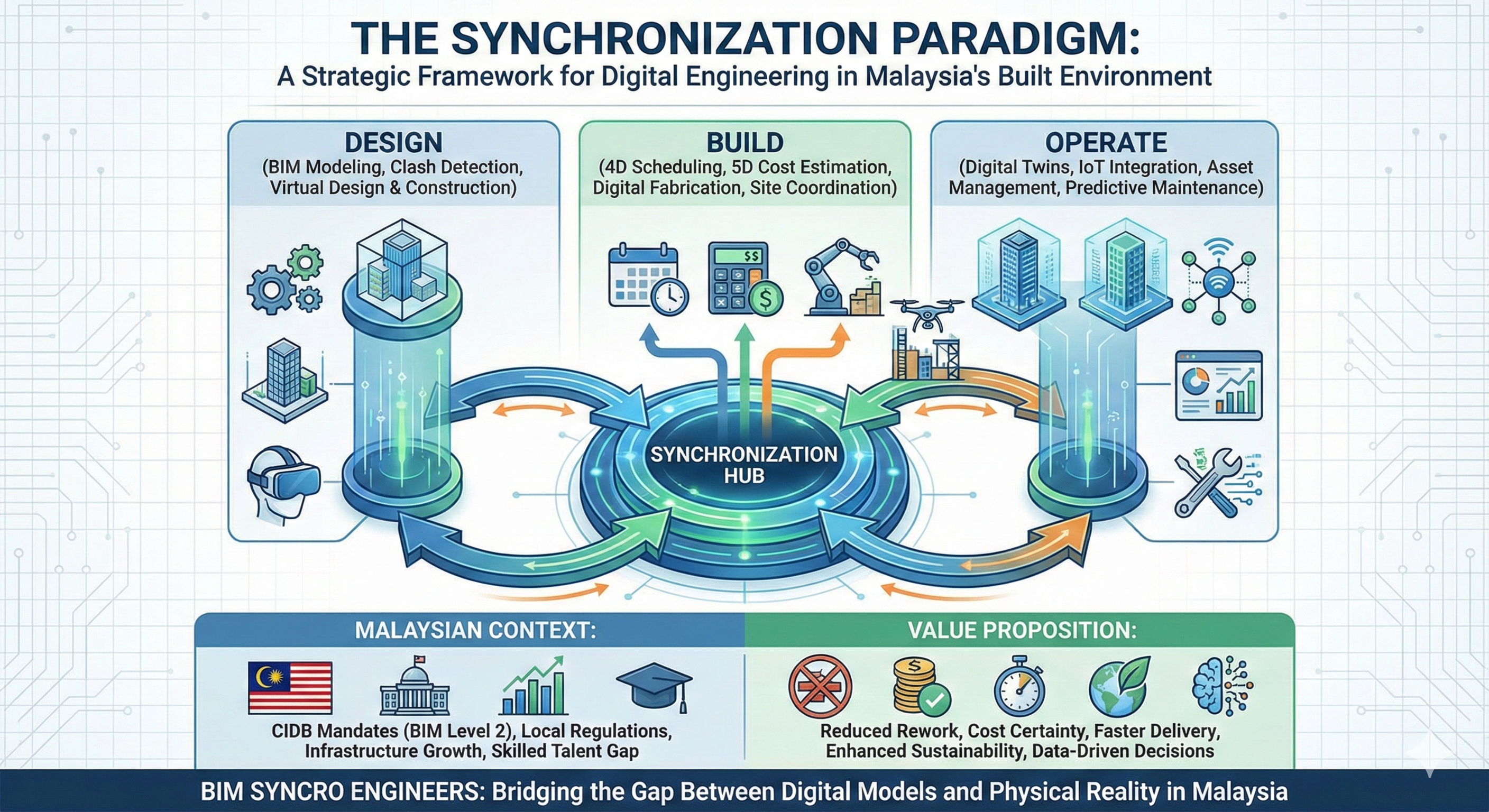
BIM Syncro treats BIM as a decision system across dimensions, not a modelling exercise:
-
4D: construction sequencing, logistics conflicts, and schedule risk
-
5D: cost exposure, variation forecasting, and cashflow visibility
-
7D: asset data structured for operations, maintenance, and lifecycle planning
The result is predictive insight—problems are simulated before they appear on site, not explained after the damage is done.


3. Built for Malaysian SMEs, not just Tier-1 players
Most BIM consultants assume clients already own:
-
Full BIM software stacks
-
Dedicated BIM departments
-
Time and budget for long learning curves
BIM Syncro removes these assumptions:
-
Project-based BIM delivery instead of forcing full software ownership
-
Embedded BIM teams that work alongside contractor staff
-
Practical, role-based upskilling tied to live project outputs, not abstract training
This allows SMEs to comply, compete, and scale—without betting the company on licenses and headcount.
4. Local authority fluency beats low-cost outsourcing
Generic BIM outsourcing optimises hourly rates. BIM Syncro optimises project outcomes in Malaysia:
-
Familiar with JKR, CIDB, MOF, utilities, and concessionaire requirements
-
Understands local submission formats, naming conventions, and review cycles
-
Structures BIM data to match how Malaysian assets are actually operated, not textbook FM models
That local grounding is what keeps PeDATA and SKATA intact after handover, when most outsourced BIM models quietly fail.
BIM Syncro vs generic BIM outsourcing
| Dimension | Generic BIM Outsourcing | BIM Syncro |
|---|---|---|
| PK 1.15 readiness | Reactive | Embedded from start |
| PeDATA / SKATA | Parameter add-on | Structured asset data |
| SME cost barrier | High | Scalable, project-based |
| Predictive capability | Mostly visual | 4D / 5D / 7D intelligence |
| Local approvals | Weak | Authority-aware |
| Operations value | Limited | Ops-ready, lifecycle data |
Why this unlocks predictive intelligence
Predictive intelligence does not come from AI slogans—it comes from disciplined data:
-
Correct structure
-
Consistent attributes
-
Lifecycle continuity
By aligning BIM delivery to PK 1.15, PeDATA, and SKATA from day one, BIM Syncro produces datasets that can be simulated, analysed, and reused—where design informs construction, and construction informs operations.
That is how BIM stops being a compliance cost and becomes a strategic operational asset.
Conclusion
If BIM stops at models, compliance is superficial and operational value is lost.
BIM Syncro’s real advantage is not software—it is local regulatory intelligence, SME-practical delivery, and predictive, lifecycle-ready BIM.
For Malaysian constructors navigating PK 1.15, PeDATA, and SKATA, this is the difference between outsourcing drawings and owning outcomes.
References & further reading
-
BIM Syncro Engineers – Services, approach, and track record
https://bimmalaysia.com -
Ministry of Finance Malaysia – Pekeliling Perbendaharaan PK 1.15
https://www.mof.gov.my -
CIDB Malaysia – BIM adoption and national standards
https://www.cidb.gov.my -
JKR Malaysia – BIM and digital delivery initiatives
https://www.jkr.gov.my
Recommended Post
BIM Compliance Malaysia

Beyond Outsourcing: Why Strategic Leaders Choose BIM Syncro