BIM & Digital Twin Integration Built for Operational Intelligence

The average BIM and digital twin implementation looks impressive during project delivery—and quietly dies after handover.
Typical symptoms:
-
BIM models frozen as static as-builts
-
Digital twins reduced to dashboards with no decision authority
-
IoT data disconnected from engineering intent
-
Compliance documents scattered across systems
-
No ownership model for data after construction
This is not a tooling failure.
It is an architecture failure.
BIM Syncro deliberately avoids this trap.
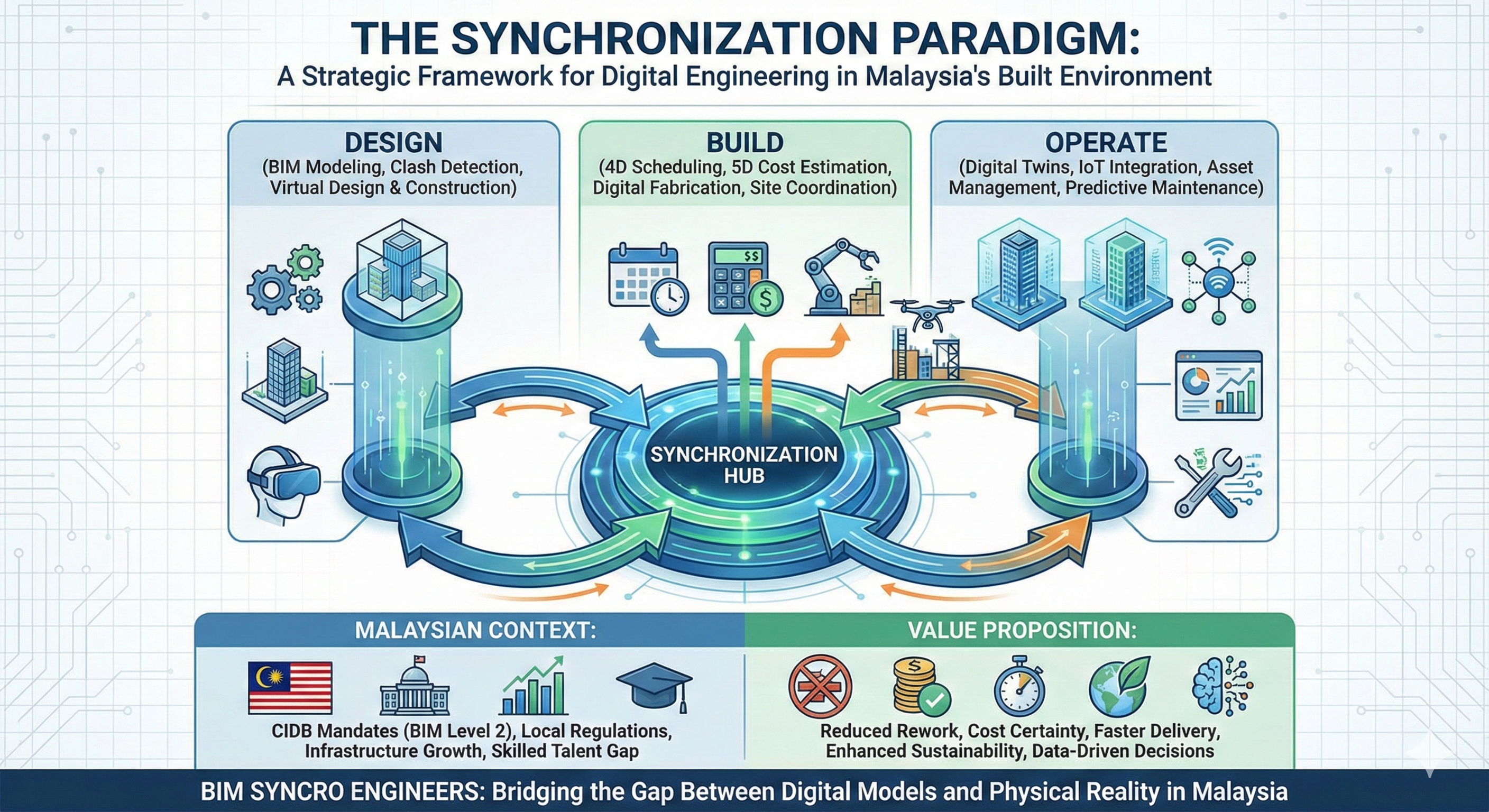
1. Integrated Project Delivery: BIM as a Single Source of Operational Truth
The average approach
-
BIM used mainly for clash detection
-
4D/5D treated as optional add-ons
-
Disciplines coordinate temporarily, then disband
BIM Syncro’s approach
-
Establishes unified BIM workflows from day one
-
Aligns geometry, schedule, cost, and method into a single delivery logic
-
Treats multidisciplinary coordination as a continuous system, not a phase
How this changes outcomes
-
Decisions are made once, not re-litigated downstream
-
Schedule and cost impacts are visible before construction, not after
-
BIM becomes a decision record, not just a coordination tool
BIM Syncro designs BIM to carry intent forward, not just solve clashes.
2. Digital Twin Development: From Representation to Authority
The average approach
-
Digital twins presented as real-time visualizations
-
Data streamed, but not contextualized
-
Dashboards show conditions but don’t guide action
BIM Syncro’s approach
-
Builds digital twins that retain:
-
Engineering assumptions
-
Design constraints
-
Operating thresholds
-
-
Links live data back to why the asset was designed that way
How this changes outcomes
-
Monitoring becomes diagnosis
-
Alerts become decisions
-
Operations teams gain predictive insight, not just status updates
A BIM Syncro digital twin does not just reflect reality—it interprets it.
3. Data & Systems Integration: Engineering Logic Before Connectivity
The average approach
-
Connects BIM to IoT, FM, ERP, or SCADA by interface availability
-
Prioritizes dashboards over data lineage
-
Treats integration as an IT problem
BIM Syncro’s approach
-
Starts with engineering semantics, not APIs
-
Defines:
-
Asset identity
-
System boundaries
-
Cause-effect relationships
-
-
Integrates BIM with enterprise systems only after meaning is preserved
How this changes outcomes
-
Data stays trustworthy
-
Systems speak the same language
-
Operators know not just what is happening, but why
Connectivity without context creates noise.
BIM Syncro builds context first.
4. Regulatory & Compliance Enablement: BIM as an Audit-Ready System
The average approach
-
Compliance documents generated separately
-
BIM models disconnected from submissions
-
Audit trails reconstructed manually
BIM Syncro’s approach
-
Embeds compliance requirements directly into BIM workflows
-
Aligns outputs with recognized frameworks:
-
ISO 19650
-
IFC
-
OpenBIM
-
-
Ensures models, documents, and records are traceable and defensible
How this changes outcomes
-
Faster approvals
-
Cleaner audits
-
Reduced compliance risk over the asset lifecycle
In BIM Syncro’s model, compliance is designed in, not chased later.
The Core Difference: BIM as Infrastructure, Not Software
Most BIM failures happen because BIM is treated as:
-
A software skill
-
A project deliverable
-
A temporary coordination layer
BIM Syncro treats BIM as:
-
Information infrastructure
-
A lifecycle system
-
A long-lived operational asset
This requires:
-
Architectural discipline
-
Governance thinking
-
Deep engineering grounding
It is harder.
It is slower at the beginning.
And it pays off for decades.
Conclusion
BIM Syncro does not take the average approach to BIM and digital twin integration because the average approach does not survive reality.
Where others optimize for:
-
Visuals
-
Speed
-
Minimal compliance
BIM Syncro optimizes for:
-
Continuity
-
Accountability
-
Operational intelligence
BIM is not the end product.
It is the spine of how assets think, operate, and evolve.
That is why BIM Syncro builds it differently—and why it works when the glossy models are long forgotten.
Recommended Post

How To Unlock Predictive Intelligence for Operations and Design
BIM Compliance Malaysia
